

How to use a metronome speed trainer
Choose a start tempo that feels controlled, a modest target and a small increase after several complete bars. Aim to keep the passage accurate and relaxed as the tempo rises, rather than only reaching the target number.
On this page
A first tempo ramp
Check the setup
- Meter
- 4/4
- Tempo
- 60 → 90 BPM · quarter note beats
- Subdivisions
- Main beats
- Swing
- Straight
- Accent sound
- On
- Mode
- Speed Trainer
- Count-in
- 1 bar
- Change
- 5 BPM every 4 bars
Opens in a new tab. Review the settings, then press Start when ready.
- Play the passage accurately three times without the trainer and choose that tempo as the start.
- Set a target 20–30 BPM higher, not your absolute maximum.
- Use a 5 BPM change every four bars.
- During each block, keep the same movement and subdivision.
- Stop if errors repeat, the pulse becomes uneven or tension rises.
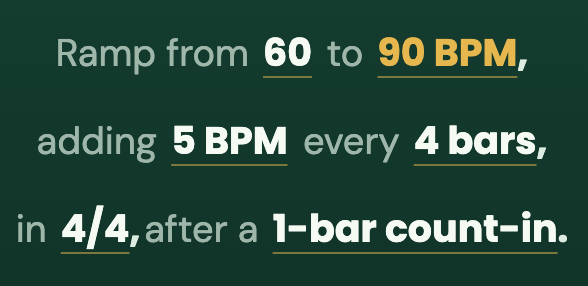
Example: the linked 60 → 90 BPM Speed setup · Main beats
- Raise the tempo after four complete bars. Start at 60 BPM, aim for 90 BPM and add 5 BPM every four bars. This 4/4 example begins with a one-bar count-in and uses Main beats. Choose an underlined value in the actual setup to edit it. The trainer plays a complete final block at 90 BPM before finishing.
Optional progression
If the full ramp stays clean, repeat it the next day or raise both start and target by 5 BPM. If one step breaks down, lower the start or use eight-bar blocks so the movement settles before the next change.
Common mistakes
- Using changes that are too large: smaller steps make it easier to hear where control was lost.
- Repeating wrong notes: lower the tempo before continuing.
- Holding your breath: reduce the target if the higher tempo adds tension.
Success criterion
The ramp is ready to progress when the notes stay accurate, the rhythm stays steady and your movement stays relaxed through the final block. If reaching the target makes any of those worse, lower the target and try again.
Gap metronome practice
Change one source of support after the present task is repeatable.
Try the next practice